国产精品无码免费专区午夜_精品无码国产一区二区三区51安_AV无码久久久久不卡蜜桃_在线观看片免费人成视频无码

October - December 2001

Contents

Bulletin of 1999 Events Completed
Preliminary Bulletin Posted
Station Coverage Maps Posted
ISC Paper in BSSA
ISC Posters at AGU
Robin Adams in Zürich

Bulletin of 1999 Events Completed

The Bulletin of December 1999 events was posted to the ISC web site in late October and the CD for all of 1999 was distributed a few weeks later. Analysis of 1999 was finished ahead of schedule thanks to improved automatic processing and a scheme for concentrating manual analysis on events that require attention.

For the first time, this year's Bulletin includes data for contributed events that do not warrant manual analysis at the ISC. Results from automatic processing were reviewed for 52,000 events, but the total number of events for which the Bulletin includes data jumped from 66,000 in 1998 to 155,000 in 1999. The events integrated into the Bulletin but not reviewed by ISC seismologists were generally too small to be detected by more than a single network.
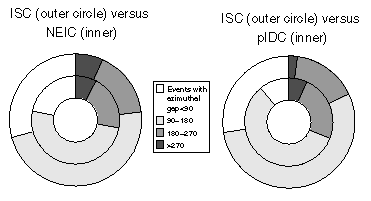

For events in common with other global summaries, the ISC Bulletin often includes stations sufficient for a more accurate or more reliable solution.

While manual review at the ISC focuses on events with a reported magnitude of 3 or more, contributors are encouraged to send data at least for all M>2 events. Even with this threshold, further improvement in collection could result in a several-fold increase data volume.

The ISC computed mb for 13,500 events of 1999. The worldwide completeness threshold indicated by roll-off of the magnitude-frequency relation was near mb 4.3, as it has been since 1995. Also typical for the late 1990's, about half of the amplitudes used to compute ISC mb are from the prototype International Data Centre (pIDC), mainly because many other agencies do not measure teleseismic amplitudes. Very few events for which the ISC did not compute mb were detected at all teleseismically, but completeness to mb<4 in well-monitored regions suggests that improvement is possible elsewhere.

Processing of readings from disparate contributors reveals the existence of fewer previously unrecognised mid-ocean events than in years past. Nevertheless, the ISC continues to discover dozens of new events each year between seismological networks, even near international borders within Europe.

The reviewed events in the Bulletin have an average of 21 initial phases each. This is close to the average for the last 10 years, reflecting a balance between the growing number of small events that are included and collection of more phase data. The number of later phases equalled about 51% of the number of initial phases, which is within the range of 43% to 53% that holds for almost every year of the Bulletin since 1964.
Preliminary Bulletin Posted

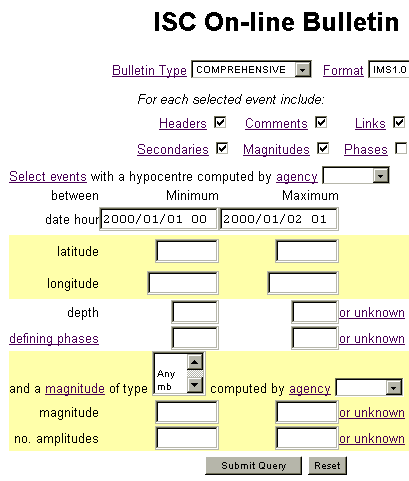
The ISC web site and e-mail servers now offer a preliminary Bulletin that includes even the most recently contributed data. Periodic re-processing excludes most duplicate readings and hypocentres, groups independently computed hypocentres for the same events, and associates phase readings with events.

Many smaller events are found only in regional catalogues that are not available in final form until more than a year later, but most large earthquakes (M>5) are reported soon after they occur. ISC's automatic grouping and association are subject to review by ISC seismologists, but only a few per cent of processing results are changed in analysis so the preliminary Bulletin is generally reliable.

The on-line Bulletin includes links to further data for most of the larger events, including details regarding calculation of moment tensors and source time functions, as well as sets of Spyder® and FARM waveform segments from the IRIS DMC and the Orfeus Data Centre.

Further development in the near future is planned to include maps and links to other on-line databases, especially when criteria used in selecting events from the ISC Bulletin suggest interest in further data that the ISC knows of elsewhere.

Station Coverage Maps Posted

Readings from more than 2500 seismic stations helped to ensure reliability of the Bulletin of 1999 events. But the density of stations varies widely around the world, partly because the ISC aims to be comprehensive rather than uniform. The effect of station density is important but difficult to quantify. It can be hard to distinguish between true changes in seismicity and artefacts from changes among reporting stations, for example, especially if magnitude is not computed for some events.

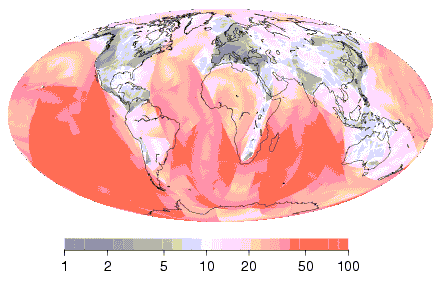
A general view of detection capability can be gleaned from station distribution statistics such as azimuthal gap, i.e. the largest angle between two adjacent stations as viewed from an event. If the stations that detect an earthquake leave an azimuthal gap more than 180° then it may not be possible to compute an epicentre and the event may fail to be included in the Bulletin.

Within a sufficiently small distance from any point a seismic network includes no more than two stations, which unavoidably have an azimuthal gap of at least 180°. Conversely, when stations at sufficiently large distances are included then azimuthal gap is less than 180° around any point within a network. The coverage of a network at a particular location can be characterised by the distance beyond which one must go to find stations with an azimuthal gap less than 180°.

If arrival times at two or more stations in any semicircle around an event are used to compute a location then no single arrival time controls a trade-off between epicentre and origin time. Thus the distance at which the second azimuthal gap (i.e., azimuthal gap ignoring the most isolated station) falls below 180° is sometimes regarded as a better measure of network coverage. A global map of this distance among stations that contributed to the 1999 ISC Bulletin is show below, and regional maps of station coverage are available at http://www.gxjydl.com/doc/misc/gapmap/index.html

It is unsurprising that detection at teleseismic distances is required to reliably locate events in the oceans, but the maps also show that island stations can be critical to effectively illuminate our view of seismicity off shore from even extensive continental networks. Coverage is understandably sparse in parts of some continents where large earthquakes occur only infrequently, such as eastern South America and Saharan Africa. In addition, however, the maps show that reporting stations were insufficient for good coverage during 1999 in parts of western South America, and northernmost Africa, and much of central Asia.

Members of the ISC staff are working to improve data exchange with earthquake monitoring agencies around the world, especially where coverage is sparse. New catalogues have been contributed from Vietnam and Iran, and additional bulletins are hoped for from Peru, Algeria, Kyrgyzstan, Korea and Iceland. Nevertheless, Bulletin users are encouraged to suggest other agencies that might contribute a catalogue or bulletin to the ISC.

ISC Paper in BSSA

"Global test of seismic event locations using three dimensional earth models" was published in the December 2001 Bulletin of the Seismological Society of America. The paper summarises the work of Chen Qi-fu of the China Seismological Bureau during his Royal Society fellowship at the ISC. Qi-fu showed that each of several 3D models improves agreement between computed hypocentres and well-known locations of explosions and earthquakes. Reprints can be requested from Qi-fu (chenqf@seis.ac.cn) or the ISC.

ISC Posters at AGU

At the AGU Annual Fall Meeting ISC seismologists Dmitry Storchak, Mamy Andrianirina and Esmeralda Banganan authored a poster summarising the 1999 Bulletin. Among many features of the Bulletin, they showed how the ISC's comprehensive data collection results in hypocentres that are generally more reliable than those in other global catalogues for comparable events.

Ray Willemann presented an analysis of residuals from Chen Qi-fu's relocation of 3800 ISC events around the world using a tomographic model, and from a further relocation using the one-dimensional ak135 model. He showed that ak135 improves residuals compared with those from the Jeffreys-Bullen tables that are used in ISC operations, and that further improvement from the tomographic model is also statistically significant. But Ray concluded that each increment is marginal in any particular region, and only the combination of a both a better 1D base model and 3D perturbations provides important improvement in many areas.

Robin Adams in Zürich

Robin Adams was invited as a Resource Expert to the first workshop of the PEGASOS project, a Probabalistic Seismic Hazard Study for nuclear power plants in Switzerland, carried out by the Swiss National Cooperative for the Disposal of Radioactive Waste for the Swiss Federal Nuclear Safety Inspectorate. Robin attended the meeting near Zürich in October and gave a presentation "Experience of the ISC Related to Location and Magnitude Errors and Uncertainties in European Earthquake Catalogues"

国产精品无码免费专区午夜_精品无码国产一区二区三区51安_AV无码久久久久不卡蜜桃_在线观看片免费人成视频无码

      日韩国产小视频| 青娱乐精品在线| 在线观看国产福利| 最新黄色av网站| 国产一区二区视频免费在线观看| 亚洲天堂一区二区在线观看| 丰满爆乳一区二区三区| 男同互操gay射视频在线看| 欧美国产日韩在线播放| 成人免费看片视频在线观看| 在线视频日韩一区| 你懂的av在线| 91免费版看片| 亚洲涩涩在线观看| jizzjizzxxxx| 欧美精品在欧美一区二区| 一区二区三区 日韩| www.av毛片| 国产树林野战在线播放| 欧美一级片免费播放| 中文字幕22页| 欧美韩国日本在线| 国产一线二线三线女| 波多野结衣激情| 在线免费av播放| 久久国产乱子伦免费精品| 91视频 - 88av| 五月天国产视频| 亚洲精品怡红院| 欧美视频在线播放一区| 中文字幕日韩精品无码内射| 日韩高清在线一区二区| 99re精彩视频| 国产免费人做人爱午夜视频| 成年人午夜视频在线观看| 成人毛片100部免费看| 久久久一二三四| 一级做a免费视频| 亚洲一级片免费| 黑森林福利视频导航| 欧美不卡在线播放| 男人添女人荫蒂免费视频| 轻点好疼好大好爽视频| 日韩精品综合在线| 成年人网站国产| 大陆av在线播放| 免费高清一区二区三区| 成人一区二区av| 国产尤物av一区二区三区| 狠狠干视频网站| 8x8x华人在线| 国产女教师bbwbbwbbw| 草草草视频在线观看| 日本特黄在线观看| 天天爱天天做天天操| 少妇熟女一区二区| 午夜影院免费观看视频| 欧美视频国产视频| 日本免费在线视频观看| 伊人成人免费视频| 99re99热| 丁香六月激情网| 九九爱精品视频| 9久久9毛片又大又硬又粗| 日韩一级性生活片| 成人免费观看cn| 国产精彩免费视频| 日韩精品视频一二三| 91网址在线观看精品| 粉嫩av一区二区三区天美传媒 | 欧美大尺度做爰床戏| 91亚洲免费视频| 国产精品嫩草影视| 欧美交换配乱吟粗大25p| 日本精品久久久久久久久久| 久久精品国产精品亚洲色婷婷| 久久久国产欧美| 九九热精品国产| 欧美a级免费视频| 精品国产成人av在线免| 999在线观看| 日本成人在线不卡| 欧美日韩在线不卡视频| 久久久久久久久久一区二区| 热久久最新地址| 黄在线观看网站| 黄色一级片免费播放| 欧美精品久久久久久久自慰| 密臀av一区二区三区| 免费观看黄色大片| 国产欧美日韩网站| 日本新janpanese乱熟| 国产日本欧美在线| 久无码久无码av无码| 国产极品美女高潮无套久久久| 天天干天天操天天做| 97在线免费视频观看| 国产日本在线播放| jizz欧美性11| 无码av天堂一区二区三区| 色婷婷成人在线| 日本黄色片一级片| 日韩一级免费在线观看| 男同互操gay射视频在线看| 美女黄色免费看| 午夜在线观看av| 免费视频爱爱太爽了| 日本老熟妇毛茸茸| 91免费版看片| 国产精品区在线| www.射射射| 肉色超薄丝袜脚交| 男人亚洲天堂网| 91看片淫黄大片91| 8x8x最新地址| 日韩免费视频播放| 一区二区三区日韩视频| 激情婷婷综合网| 亚洲国产一二三精品无码| 手机av在线免费| 看av免费毛片手机播放| 日韩精品手机在线观看| 手机在线国产视频| 日本888xxxx| 欧美日韩在线一| 黄色影视在线观看| 极品粉嫩美女露脸啪啪| 成人小视频在线看| www.超碰97.com| 精品无码国模私拍视频| 特级毛片在线免费观看| 国产超碰在线播放| 精品国产免费av| www.国产在线播放| 精品一区二区成人免费视频| 999精彩视频| 成人在线观看黄| 日本免费不卡一区二区| 一级性生活视频| 日本成人性视频| 在线观看免费的av| 香蕉视频网站入口| 亚洲一二三区av| 999香蕉视频| 毛片av免费在线观看| 国内自拍在线观看| 国产午夜大地久久| 国产在线视频综合| 精品人妻人人做人人爽| 国内外成人激情免费视频| 一本—道久久a久久精品蜜桃| 超碰在线资源站| 在线观看免费不卡av| 国产精品自在自线| 中文字幕 日韩 欧美| 成人性生交免费看| 97超碰人人爽| 欧美成人手机在线视频| 国模私拍视频在线观看| 五月花丁香婷婷| 亚洲黄色av片| 天堂网成人在线| 日韩视频一二三| 91成人综合网| 国产伦精品一区二区三区四区视频_| 97在线国产视频| 日韩av综合在线观看| 午夜肉伦伦影院| 国产视频在线视频| 天堂视频免费看| 国产高清免费在线| 一本大道东京热无码aⅴ| 人妻少妇精品久久| 茄子视频成人免费观看| 日本三区在线观看| 91亚洲免费视频| 五月天男人天堂| 青青草国产免费| 久草青青在线观看| 精品少妇无遮挡毛片| 久久久久久综合网| 日韩视频一二三| 99热自拍偷拍| 亚洲欧美国产中文| 777久久精品一区二区三区无码| 一二三四视频社区在线| 美女网站免费观看视频| 奇米777在线视频| 大伊香蕉精品视频在线| 国产免费人做人爱午夜视频| 国产精欧美一区二区三区白种人| 992tv成人免费观看| 国产黄页在线观看| 三级a在线观看| 国产一二三四五| 丰满人妻中伦妇伦精品app| 99热一区二区| 男女日批视频在线观看| 亚洲黄色小视频在线观看| 黄色录像特级片|