国产精品无码免费专区午夜_精品无码国产一区二区三区51安_AV无码久久久久不卡蜜桃_在线观看片免费人成视频无码

April - June 2002

Contents

Executive Committee Approves Change
Beach Balls in the Bulletin
Amplitudes Corrected
EHB Bulletin Posted
Standardising Phase Names
Threshold Adjusted

Executive Committee Approves Change

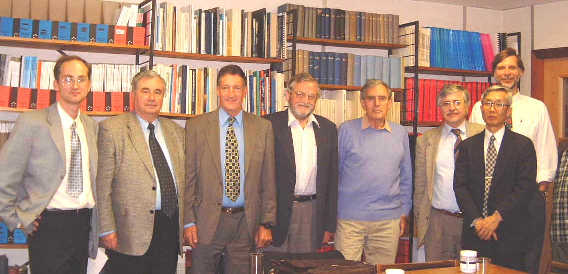
Dmitry Storchak (at left) and Ray Willemann (at right) met with the Executive Committee members (left to right) Oleg Starovoit, Chris Browitt, Gary Gibson, Adam Dziewonski, John Woodhouse and Akio Yoshida at the ISC on 6 - 7 June.

The ISC Executive Committee has given the go ahead for the most important change in ISC location procedures in more than 30 years.

Last year the Governing Council saw results from tests using S arrival times, which improved many ISC hypocentres. But depths of lower crustal events were too deep, so the Council required that the Executive Committee review further tests before ISC procedures were changed. Richard Luckett has since corrected an S phase identification error in ISC's software, and this year he demonstrated to the Committee that ISC depths using S no longer differ systematically from reported depths. The ISC will use S times to compute hypocentres for events from January 2001.

Data Collection

The Committee is pleased that the CTBT Preparatory Commission decided to exchange seismic data with the ISC, but disappointed that no provision was made for events after 2001. The Commission will meet only a few times before the ISC begins its final analysis of 2002. Data exchange must be given priority if consensus is required on a model agreement for exchanging all types of treaty monitoring data before exchanging further data with the ISC.

Committee members urged ISC staff to seek agreements with programme operators so that measurements from processing of even temporarily deployed networks are included in the ISC database. They endorsed discussions with the OBS-IP programme and with several PASSCAL investigators. But they were concerned that standardised automatic scanning for arrivals in data from PASSCAL and other programmes may be implemented without arranging to contribute results to the ISC routinely.

Staff members at the meeting described plans for ISC to co-ordinate collection and distribution of measurements from additional analysis of selected events. The Committee discussed the need to minimise additional costs, partly by starting with a small number of contributors. They also noted that the ISC database schema might need to be amended to accommodate new data types that could be contributed, such as relative arrival times from waveform cross-correlation.

Distribution

The Committee decided that a gradual reduction in the time interval between the occurrence of events and release of the ISC Bulletin should continue. The Governing Council decided last year to start cutting the interval from the two-year limit in the ISC Working Statues, and it is being reduced by about one month per year. The Committee heard that no critical data have been missed out even though some agencies barely meet the advancing schedule.

The Committee endorsed a plan to improve the next set of ISC CDs using software contributed by the British Geological Survey (BGS). The BGS is developing a Graphical User Interface to select events from data files on the CD and display them in maps and other figures. The program runs only under Microsoft Windows, but in a survey of ISC users last year most respondents who sought a graphical interface used Windows. Nevertheless, the Committee encourages other institutional members to contact the ISC staff about developing a Unix X-Windows GUI or making other in-kind contributions.

Development

The Committee was pleased the ISC has started work on a stand-alone location program and encouraged the staff to be sure that the program can be adapted readily to using data in different formats and that it is straightforward to link in an alternative Fortran location routines. The program should be developed consistently with the objectives in ISC's proposal last year to NSF regarding services for users and eventually to support on-line editing by seismologists at the ISC.

The Committee noted development of new techniques for identifying depth phases by combining waveform data from different stations. Sums of functions computed from automated triggers may be especially amenable to use at the ISC, since individual network operators could be asked to run detectors on data from their own network and report coda triggers to the ISC. ISC staff members plan to start work with several networks, and hope to present test results to Governing Council next year.

Beach Balls in the Bulletin

Thanks to a program contributed by Governing Council member Cliff Frohlich of the University of Texas, the ISC On-Line Bulletin now includes the familiar "beach ball" to represent each focal mechanism posted to users. The ISC collects focal mechanisms from more sources each year, now including regional catalogues such as those of JMA, MedNet and PNSN, as well global catalogues such as those of Harvard and NEIC.

The ISC already made it easier to use mechanisms from disparate sources together by grouping those that represent the same earthquake and rewriting from each native format to IASPEI Seismic Format (ISF). As seismologists know well, however, it is still difficult to visualise focal mechanisms by scanning lists of numbers, and comparison is even more challenging if some mechanisms are expressed as moment tensor components while others are expressed as principal axes or nodal planes.

Beach balls, which are included in the On-Line Bulletin if the "include links" option is checked, aid visualisation by graphically representing nodal planes and principal axes, regardless of how each focal mechanism is expressed. If sufficient data have been contributed to the ISC then P and T axes are marked and zones of compressional first motion are shaded. The most refined version of the figures, with non-planar nodal surfaces, is plotted if the contributed data are sufficient to determine the CLVD component of a moment tensor.

More information about focal mechanisms and beach ball figures is available from the ISC web site at http://www.gxjydl.com/doc/misc/b-balls.html

Amplitudes Corrected

Thanks are due to Tamara Jesenko of the Seismological Observatory of Ljubljana, Slovenia for spotting erroneous amplitudes in the ISC's On-line Bulletin.

For phase arrivals during January 1999 to August 2000, the ISC mistakenly interpreted amplitudes reported by the Ljubljana Observatory on broadband channels as micrometers rather than nanometers. The misinterpretation affected a total of 4422 amplitudes at stations BISS, CESS, CEY, DOBS, LJU and VBY. A further 1333 amplitudes from short period long period, and unspecified channels at the same stations during those months were not affected.

The broadband amplitudes were not used by the ISC in computing a magnitude, and so were not included in the printed Bulletin. But the incorrect broadband amplitudes for these stations are in data files on the CD of 1999 earthquakes, and were on the web site and in AutoDRM e-mails from the ISC until 28 May 2002.

By default the ISC web site and AutoDRM e-mail provides users with the "comprehensive bulletin", which includes changes after publication such as this correction of amplitudes. Users who wish to can override the default to request the "published bulletin", which provides data from the bulletin without corrections and without data added after publication. FDSN channel codes distinguish between broadband and other amplitudes. Data with channel codes can be retrieved from the ISC web site by selecting phases at particular stations in user-specified time intervals from www.gxjydl.com/search/arrivals/.

EHB Bulletin Posted

The Engdahl, van der Hilst and Buland (EHB) bulletin has been completely integrated into the ISC database. With the completion of this work, the results from EHB's re-processing of data from the ISC Bulletin are now available from the ISC web and AutoDRM servers.

EHB re-determined the identities of over 5 million arrivals, including many previously un-recognised depth phases. The new phase identifications are based on ak135 travel times, geographic variations in ocean depth, and procedures to reduce biases. Partly thanks to these identifications, EHB's hypocentres for the largest events from the ISC Bulletin may be better for tomography and some other purposes than those originally computed by the ISC.

Users interested exclusively in events re-processed by EHB can use the ISC's standard web page for earthquake data, http://www.gxjydl.com/search/bulletin/, and select "EHB" in the "agency" pull-down menu. To retrieve EHB's identifications of phases associated with these events, users should additionally select "collected" in the "bulletin type" pull-down menu. Users with general interest in special sets of data collected by the ISC, such as the EHB bulletin, may find it more convenient to us links in http://www.gxjydl.com/doc/misc/special.html rather than starting from the blank bulletin selection page.

Standardising Phase Names

Accurate identification of phase arrivals is one of the most important features of both the ISC Bulletin and regional bulletins on which the ISC's work is based. To ensure that identifications are as reliable as possible, the ISC keeps three identifications for each phase: the name just as reported, an interpretation of the reported name in ISC's nomenclature, and ISC's own identification based on the depth of the associated origin and its distance from the station.

Standardising phase names among seismologists would reduce the chance of mis-interpretation and ease reliable exchange of bulletins. ISC's senior seismologist Dmitry Storchak took a big step towards this goal by leading an IASPEI working group on phase names. Following a public comment period, the working group finalised its consensus list of names, which is now posted on the ISC website.

Most likely, this list will be endorsed by IASPEI's Commission on Seismic Observation and Interpretation at its meeting next year. Then the real work will begin as the group works to persuade agencies around the world to adopt the standardised names in their own bulletins. This will be easier, of course, if the group can convince authors of widely used programs such as SeisAn, Antelope and SAC to modify the programs to use names from their list.

Threshold Adjusted

ISC seismologists did not review of most 3.0-3.4 JMA events during June, July and August 2000. This is a departure from standard procedures at the ISC, which include reviewing all events with a reported magnitude of 3 or more, with a reported arrival at a station more than 5º from the epicentre, or with reported data from two or more agencies. Each event that met any other criterion was reviewed no matter how small its magnitude.

The reason for temporarily adjusting the threshold with regard to JMA magnitudes was a prolific swarm of activity near Honshu, which included large earthquakes on 6 June and 30 July 2002. Analysis of the smaller events by ISC seismologists would have delayed production of the Bulletin and added little to JMA's analysis of events that were not recorded beyond Japan.

国产精品无码免费专区午夜_精品无码国产一区二区三区51安_AV无码久久久久不卡蜜桃_在线观看片免费人成视频无码

      你真棒插曲来救救我在线观看| 日韩中文字幕免费在线| 波多野结衣乳巨码无在线| 天天天干夜夜夜操| 国产精品无码电影在线观看| 热久久精品国产| 中国女人做爰视频| 男女爽爽爽视频| 日韩网站在线免费观看| 亚洲怡红院在线| 国产精品50p| 992tv成人免费观看| 91插插插插插插插插| 免费无码毛片一区二三区| 91香蕉国产线在线观看| 中文久久久久久| 蜜桃传媒一区二区三区| 99re8这里只有精品| 欧美在线aaa| 午夜精品久久久内射近拍高清| 乱熟女高潮一区二区在线| 毛片毛片毛片毛| 国产视频在线视频| 九色在线视频观看| 国产日韩亚洲欧美在线| 中文字幕免费高| xxww在线观看| 国产小视频精品| 国产裸体舞一区二区三区| 成年人午夜免费视频| 国产小视频免费| 久久免费视频2| 国产成人美女视频| 日韩av在线中文| www.日本xxxx| 可以免费观看av毛片| 欧美 日本 亚洲| 日韩伦理在线免费观看| 国产911在线观看| 黄色一级片网址| www.51色.com| 中文国产在线观看| 污污的网站免费| 艹b视频在线观看| 日本久久精品一区二区| 不卡av免费在线| 九九视频精品在线观看| 中文字幕在线观看第三页| 波多野结衣家庭教师视频| heyzo亚洲| 噜噜噜久久亚洲精品国产品麻豆| 日韩网站在线免费观看| 欧美 日韩 亚洲 一区| 国产伦精品一区二区三区四区视频_| 日韩一级性生活片| 日韩欧美猛交xxxxx无码| www.国产在线播放| 人妻夜夜添夜夜无码av| 北条麻妃在线视频观看| 最近免费中文字幕中文高清百度| 黄色片一级视频| 无码内射中文字幕岛国片| 国产精品视频黄色| 激情五月俺来也| 天天操精品视频| 国产又粗又大又爽的视频| 国产一级大片免费看| 男人天堂a在线| 男人用嘴添女人下身免费视频| 116极品美女午夜一级| 日韩av播放器| 91欧美一区二区三区| 女女同性女同一区二区三区按摩| 激情图片qvod| 久久国产午夜精品理论片最新版本| 日本十八禁视频无遮挡| 天美星空大象mv在线观看视频| 日韩爱爱小视频| 欧美三级午夜理伦三级老人| 免费不卡av在线| 欧美丰满熟妇xxxxx| 欧美成年人视频在线观看| 国产盗摄视频在线观看| 久色视频在线播放| 中文字幕在线导航| 欧美一级黄色录像片| 成人毛片一区二区| 182午夜在线观看| 日本香蕉视频在线观看| 国产精品动漫网站| youjizz.com亚洲| 日本精品免费在线观看| 999在线观看| 美女黄色免费看| 一级在线免费视频| 肉大捧一出免费观看网站在线播放| 免费成人午夜视频| 一本一道久久a久久综合蜜桃| 国产日韩视频在线播放| 国产精品沙发午睡系列| 午夜国产福利在线观看| 国产 日韩 亚洲 欧美| 激情五月俺来也| 超碰成人免费在线| 激情黄色小视频| 黄色国产一级视频| 亚洲天堂av一区二区三区| 国产视频九色蝌蚪| 国产精品嫩草影视| 丰满少妇被猛烈进入高清播放| 国产探花在线观看视频| 免费黄色日本网站| 超碰中文字幕在线观看| 国产主播在线看| 国产一区一区三区| 日本人视频jizz页码69| 国产精品专区在线| 裸体裸乳免费看| 欧美伦理片在线观看| 9久久9毛片又大又硬又粗| 熟妇熟女乱妇乱女网站| 成人在线观看黄| 青青视频免费在线| 香蕉视频999| 超碰97人人射妻| 日韩一级片免费视频| www.亚洲自拍| 日av中文字幕| 精品国产一区二区三区无码| av在线免费看片| 无码日韩人妻精品久久蜜桃| 黄色大片在线免费看| 真人做人试看60分钟免费| 中文字幕av不卡在线| 久草资源站在线观看| 久久国产精品视频在线观看| 国产高清免费在线| 亚洲激情在线看| 色婷婷狠狠18| 欧美精品第三页| 欧美在线观看成人| 成人性生活视频免费看| 国产日产欧美一区二区| 国产永久免费网站| 香蕉视频禁止18| 37pao成人国产永久免费视频| 无码 制服 丝袜 国产 另类| 国产午夜精品视频一区二区三区| 91视频福利网| 日本一二三四区视频| 国产永久免费网站| 国产性生活一级片| 激情文学亚洲色图| 久久久精品高清| 欧美特黄aaa| 日韩va在线观看| 91视频这里只有精品| 国产三级三级看三级| 国产又大又黄又猛| 99re精彩视频| 99精品视频国产| 特级西西444www| 国产av不卡一区二区| mm131午夜| 91亚洲精品国产| 日本欧美黄色片| 97超碰青青草| 黄色片在线免费| 在线观看国产一级片| 在线观看日本www| 欧美三级午夜理伦三级老人| 成人手机在线播放| 国产xxxx振车| 日本网站免费在线观看| 99精品免费在线观看| 欧美三级午夜理伦三级富婆| 国产乱女淫av麻豆国产| 五月六月丁香婷婷| 九九久久九九久久| 国产午夜福利100集发布| 日韩在线xxx| 99国产精品久久久久久| 特级黄色录像片| 欧美图片激情小说| 欧美视频第一区| 亚洲娇小娇小娇小| 亚洲五码在线观看视频| 欧美视频在线观看网站 | 日韩欧美国产片| 国产手机视频在线观看| 免费在线看黄色片| 国产欧美高清在线| 国内国产精品天干天干| 300部国产真实乱| 1024av视频| 污视频网站观看| 在线观看17c| 麻豆av免费在线| 日韩第一页在线观看| 免费在线观看亚洲视频|