国产精品无码免费专区午夜_精品无码国产一区二区三区51安_AV无码久久久久不卡蜜桃_在线观看片免费人成视频无码

April - June 2003

Contents

Executive Committee and Governing Council Meet
New Director Selected
Prompt Access to Collected Data
Testing New Travel Times to Improve Hypocentres

Executive Committee and Governing Council Plan Further ISC Development

The ISC Executive Committee and Governing Council each met in Sapporo, Japan during the IUGG Assembly. The Executive Committee evaluated ISC's recent work in detail and outlined plans for the next few years. The Governing Council met more briefly to review and revise the Committee's plans.

New Location Capabilities Hailed

A highlight of both meetings was iscloc, the program for computing hypocentres and magnitudes that ISC released this year. Hypocentres and magnitudes from iscloc match those from programs used to prepare the Bulletin. But iscloc's thorough documentation and modular design make it straightforward to use new travel times, attenuation relations, and algorithms. Already iscloc has been used to show that static corrections from a global crustal model would not make ISC hypocentres more accurate.

In contrast, use of S arrival times has successfully improved ISC hypocentres. Primarily thanks to local and regional S times, the ISC now more often computes both depths and epicentres from arrival times reported by all networks. Users also benefit from the ISC's specific identification of Sg, Sb and Sn phases.

The Executive Committee placed a high priority on developing a few auxiliary programs that would be required to support use of iscloc in ISC operations. After that, they recommended, the ISC should enhance iscloc to use travel times from 3-dimensional earth models. The Council endorsed this approach, and called for a workshop on hypocentral accuracy at the next IASPEI Assembly. Governing Council might then consider if the ISC should use new travel times to compute prime hypocentres.

Improving Data Collection

The Council noted that the ISC now completes routine data collection two months closer to real time than when the Council last met, and incorporates data for even the smallest earthquakes into its database. They decided that the ISC should continue aiming to improve the timeliness of data collection and the ISC's own final analysis, with a goal of completing collection about 17 months after real time by mid-2005.

The Executive Committee discussed strategies for promoting wider use of the archiving and re-distribution service that ISC now offers for catalogues and arrival time picks from research projects, such aftershock studies and other temporary deployments of on-land and ocean bottom seismic stations. Journal publishers and funding agencies will be asked to encourage authors and grant recipients to deposit catalogues in publicly accessible databases.
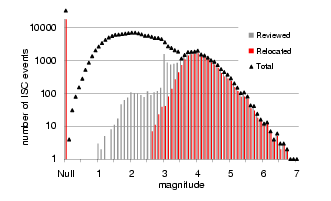
A figure from one of Dmitry Storchak's posters at IUGG shows effects described to the Governing Council from removing collection thresholds. ISC collected and re-distributed data for more than 180,000 earthquakes that occurred during year 2000 even though only 44,000 warranted review by ISC seismologists. Thanks partly to the use of S arrival times, the ISC was able to compute its own hypocentre for more than 80% of the reviewed events.

The meetings also featured discussion of the ISC making its own measurements from waveform segments that can be retrieved on the Internet. The ISC's initial efforts are related to a NERC-funded project to automatically measure SKS splitting. But the system that is being developed could be used to support automatic picking of secondary arrival times or to improve magnitudes by measuring more amplitudes.

Updating Data Distribution

The Governing Council confirmed its provisional decision of 2001 to stop printing the Regional Catalogue after volume 37, which had data for the events of 2000. The Council noted that users are still able to access Catalogue information readily using the range of services offered by the ISC on the Internet and from the ISC's CD-ROMS. The CD-ROMS will continue to include the Catalogue as PDF documents and as FFB files and ISF data files, which can be read from the WizMapII GUI.

The Governing Council also adopted a recommendation from the Executive Committee to reduce the size and frequency of the printed Bulletin. The suppression of arrival times and amplitudes from the printed Bulletin for the events of 1996-2001 will be extended to all events of 2002. This change facilitates cutting the frequency of printing from 6 per year to 3, making it affordable to include a CD-ROM with each printed issue. This change improves timeliness in making some data available, since the CD-ROMs include phase readings for even the smallest events.
New Director Selected

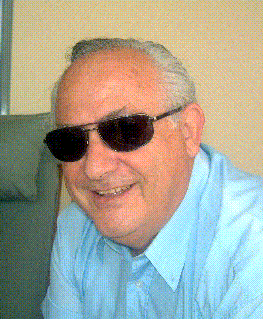
The ISC Governing Council has selected Dr Avi Shapira as the ISC's next director. Avi will assume leadership of the ISC in January 2004, when Ray Willemann plans to step aside.

Avi has extensive experience managing a scientific organisation, as director general of the Geophysical Institute of Israel (GII) since 2002 and before that as director of GII's Seismology Division since 1982. At GII Avi managed design and operation of Israel's national seismic network, national strong motion monitoring network, and a pool of portable seismic stations. He led, in parallel, development and implementation of new methods and procedures at GII to make full use of data from the networks.

Avi's wide range of experience in international seismology includes his participation in governing the ISC and the European-Mediterranean Seismological Centre. Avi was vice president of the European Seismological Commission (1996-2000), is Israel's national representative to the Asian Seismological Commission, and is a long-serving member of several IASPEI Commissions. He has participated in seismological field experiments in many regions, including Central America, the Caribbean, Central Asia, the South Pacific, and the Middle East.

Avi's expertise in seismology will be an important asset in the coming years as the ISC undertakes development to improve hypocentres and magnitudes using its new program "iscloc". Avi is an author of more than 40 peer-reviewed papers and nearly 50 invited reviews and publications in conference proceedings. Under his leadership, GII has been an important participant in efforts to improve hypocentres computed from seismic stations used to monitor the Comprehensive Test Ban Treaty.

Most importantly, perhaps, Avi brings a strong commitment to the ISC's mission and to improving ISC's services to seismologists. "The ISC has its footprints in my professional activities and career since the days I picked phases on WWSSN film records and telexed them to the prestigious Centre," says Avi. "Now ISC must explore improvements based on the development of new location methods, new travel time models, and new techniques for location error estimates."

Prompt Access to Collected Data

The ISC makes data available promptly after it receives them, which in some cases is many months before analysis for the Bulletin. Collected data are available from the ISC's web server as the recent part of the "Comprehensive Bulletin".

The ISC's data capture system automatically parses data from most e-mail, so new data may be added to recent months of the Comprehensive Bulletin at any time. Inserting data triggers a procedure to group hypocentres that are likely to be different estimates for the same event. Another procedure runs during off-peak hours to associate phase arrivals with the prime hypocentre for each event.

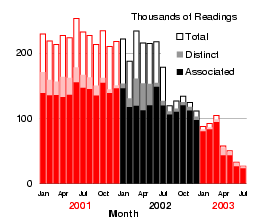
The figure at right shows the status of phase readings in the Comprehensive Bulletin at the end of July. At that time, the database included the results from the ISC's final analysis through 2001 September, data from NEIC's PDE through 2002 July, and data from IDC's REB 2002 December, and data from the JMA bulletin through 2003 March.

The figure reflects that

  • Apart from the REB and PDE, most readings are contributed within a few months after the events.
  • NEIC's PDE is the source of most duplicate phase readings, but also of about 20% of distinct readings.
  • ISC's automatic association had not been re-run recently on Mar - Apr 2002, so recently collected readings were not yet associated with events.
  • Otherwise, nearly all distinct phases are automatically associated with an event, and thus are included in the Comprehensive Bulletin.

The only things missing from the preliminary part of the Comprehensive Bulletin are hypocentres computed by the ISC from the union of all associated phase readings and, of course, the judgement of ISC seismologists about the accuracy of the automatic grouping and association. For example, ISC seismologists disassociate as many as 10% of the distinct phases that automatic processing had deemed might be related to particular events.

Testing New Travel Times to Improve Hypocentres

Mike Ritzwoller of the University of Colorado and Adam Dziewonski and Mike Antolik of Harvard University have contributed software to the ISC for computing travel times in 3-dimensional earth models. Istvan Bondar of the Centre for Monitoring Research verified versions of the programs delivered to the ISC.

These programs newly available to the ISC compute true minimum travel times, including the effect of lateral variations in wave speed on the geometry of ray paths. Richard Luckett of the ISC has used the programs to compute travel times through models of the crust and the upper and lower mantle that Ritzwoller and Dziewonski contributed with the software. Richard incorporated his results into functions that rapidly re-compute times by interpolating among tabulated values.

In contrast to results when he ran tests with crustal models that incorporate lateral variability, in this case Richard found that both residuals and hypocentres for ground truth events were improved.

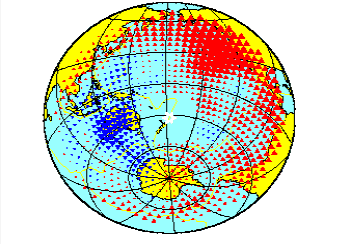
The ISC would face many challenges if it were to use these sorts of models to compute hypocentres all around the world. From a scientific perspective, the models may lack sufficient resolution in regions without many earthquakes or local stations. Of course, earthquakes or stations are sparse in most oceans and even some broad continental regions. From a technical perspective, station-specific tables may become awkwardly large when many hundreds of stations are involved and when travel times must be tabulated for secondary phases and depth phases, both at several depths.

An example of source-specific station corrections computed from the Harvard University model. The size of each red or blue triangle represents the size of the positive or negative correction for P travel time from a source at the surface

国产精品无码免费专区午夜_精品无码国产一区二区三区51安_AV无码久久久久不卡蜜桃_在线观看片免费人成视频无码

      亚洲第一精品区| 在线观看av日韩| 日本人69视频| 无码中文字幕色专区| 中文字幕在线视频一区二区三区| 国产无限制自拍| 色婷婷综合在线观看| 国产av无码专区亚洲精品| 亚洲激情免费视频| 最新天堂中文在线| 免费裸体美女网站| 老太脱裤子让老头玩xxxxx| 搡的我好爽在线观看免费视频| 妞干网在线免费视频| 国产美女作爱全过程免费视频| 精品亚洲一区二区三区四区| 浮妇高潮喷白浆视频| 日韩精品第1页| www.51色.com| 777视频在线| 免费日韩视频在线观看| 青草青青在线视频| 久久综合亚洲精品| 黄黄视频在线观看| 日本成人xxx| 五月激情五月婷婷| 一路向西2在线观看| 成人精品视频一区二区| 国产肥臀一区二区福利视频| 久青草视频在线播放| 青草全福视在线| 日韩欧美中文视频| 国产在线观看中文字幕| 三上悠亚在线一区| 欧美特级aaa| 777视频在线| 久久婷五月综合| 少妇网站在线观看| 中文字幕av不卡在线| 亚洲高清在线免费观看| 欧美日韩在线成人| 日本爱爱免费视频| 色一情一乱一伦一区二区三区日本| 国产在线青青草| 日本三级免费观看| 成人小视频在线看| 国产精品免费成人| www黄色在线| 91最新在线观看| 免费涩涩18网站入口| 亚洲精品久久久中文字幕| 日韩一级理论片| 午夜久久福利视频| 五月天婷婷在线观看视频| 色婷婷激情视频| 永久免费在线看片视频| 少妇高潮大叫好爽喷水| 小泽玛利亚av在线| 精品国产一区二区三区无码| 妞干网在线视频观看| 草草久久久无码国产专区| www.四虎成人| 波多结衣在线观看| 精品亚洲视频在线| 粉嫩av一区二区三区天美传媒 | 日韩精品在线观看av| 久久精品xxx| 男人操女人逼免费视频| 精品人妻一区二区三区四区在线 | 国产又爽又黄ai换脸| 超碰超碰超碰超碰超碰| 毛片在线播放视频| 亚洲爆乳无码专区| 伊人色在线观看| 2022中文字幕| 色综合av综合无码综合网站| 亚洲欧美日本一区二区三区| 日韩video| aa在线观看视频| 国产熟人av一二三区| 在线播放免费视频| 久久国产精品网| 999在线免费视频| 国产高清免费在线| 免费看国产一级片| 中文字幕在线综合| 日韩欧美精品免费| 久久综合伊人77777麻豆最新章节| 亚洲热在线视频| 全黄性性激高免费视频| 亚洲精品高清无码视频| 午夜啪啪福利视频| av天堂永久资源网| 永久av免费在线观看| 2022亚洲天堂| 99热都是精品| 又色又爽又高潮免费视频国产| 日本一二三区在线| 精品99在线视频| 一本二本三本亚洲码| 国产精品wwwww| 成人在线免费高清视频| 久久综合伊人77777麻豆最新章节| 中国一级黄色录像| 一本久道中文无码字幕av| 欧美性受黑人性爽| 亚洲色图久久久| 精品国产一区三区| 欧美三级午夜理伦三级老人| 日本www高清视频| 亚洲爆乳无码精品aaa片蜜桃| jizz欧美性11| 日本三级免费网站| 喜爱夜蒲2在线| 九九热免费在线观看| 免费无码av片在线观看| 国产精品啪啪啪视频| 在线观看国产一级片| 看av免费毛片手机播放| 成人国产在线看| 久国产精品视频| 午夜免费一区二区| 免费看国产一级片| 99久久免费观看| 日韩精品在线播放视频| 中文字幕国产传媒| 欧美牲交a欧美牲交| 国产尤物av一区二区三区| 日韩不卡的av| 一级做a免费视频| 成年人免费大片| 怡红院av亚洲一区二区三区h| 久久久久久久久久伊人| 久久久精品视频国产| 韩国视频一区二区三区| 久久精品网站视频| 无码精品a∨在线观看中文| 国产xxxx振车| 日韩欧美视频免费在线观看| av不卡在线免费观看| 超碰在线资源站| 涩涩网站在线看| 久久这里只精品| 奇米影音第四色| 久久久久人妻精品一区三寸| 欧美精品自拍视频| 亚洲一区二区三区av无码| 真实国产乱子伦对白视频| 17c丨国产丨精品视频| 青草全福视在线| 欧美交换配乱吟粗大25p| 中国女人做爰视频| 日本福利视频网站| 日韩一级片免费视频| 日本男女交配视频| 亚洲国产精品无码观看久久| 欧美一级欧美一级| 少妇高潮毛片色欲ava片| 免费看日本毛片| 成年人免费在线播放| 欧美精品色婷婷五月综合| 免费日韩中文字幕| 国产自偷自偷免费一区| 中文字幕第80页| 天天干天天操天天做| 亚洲精品中文字幕乱码无线| 久久精品一二三四| 青青草视频在线视频| 分分操这里只有精品| 国产毛片视频网站| 国产精品wwwww| 日韩av卡一卡二| 欧美一级免费在线观看| 国产一区二区三区在线免费| 97视频在线免费| 国产精品动漫网站| 日韩一级免费片| 色乱码一区二区三区熟女| 欧美极品少妇无套实战| 国产精品50p| 日本中文字幕精品—区二区| 色黄视频免费看| 免费一级特黄毛片| 日本888xxxx| youjizz.com亚洲| 麻豆tv在线播放| 天天操天天爽天天射| 亚洲国产精品影视| 男人添女人下面高潮视频| 熟妇人妻无乱码中文字幕真矢织江| 午夜剧场高清版免费观看| 欧美一区二区三区综合| 日韩精品一区二区三区久久| 亚洲美女爱爱视频| 18禁裸男晨勃露j毛免费观看| 色综合av综合无码综合网站| 一个色综合久久| 日韩欧美不卡在线| 午夜两性免费视频| 800av在线免费观看|