

SUMMARY OF THE ISC BULLETIN OF EVENTS OF 2001
D.A.STORCHAKdmitry@isc.ac.uk
Presented at the EGU meeting, Nice, April 2004
- ABSTRACT
- AGENCIES CONTRIBUTING DATA TO THE ISC
- SEISMIC STATIONS REPORTING TO THE ISC
- DISTRIBUTION OF THE ISC LOCATIONS WITH THE NUMBER OF CONTRIBUTING NETWORKS
- THRESHOLDS FOR MANUAL REVIEW
- CONTRIBUTORS TO THE ISC mb AND MS
- OVERALL mb COMPLETENESS
- HOW CONSISTENT ARE THE ISC, IDC, NEIC mb AND MS ?
- RELATIVE NUMBER OF VARIOUS SEISMIC PHASE REPORTS
- USING S-ARRIVAL TIMES FOR LOCATION
- COMPARISON OF ISC, NEIC, IDC DATA SETS
- ISC EVENTS BASED ON UNASSOCIATED STATION REPORTS
- EVENTS OF SPECIAL INTEREST
- ON-LINE ISC BULLETIN
- CONCLUSIONS
The ISC Bulletin for year 2001 is now available on the Internet and the ISC CD Volume 12. In our presentation, we will give an overview of the data published in the Bulletin. We describe the major sources of data contributed to the ISC, including arrival times and amplitude readings and compare the data sets from other major data centres with that of the ISC. We discuss the magnitude threshold policy, which was applied to select events for manual review at the ISC and show the difference between the Reviewed and Comprehensive ISC bulletins. We evaluate the importance of re-analysis on a global scale from the distribution of events for which the ISC associates independently reported phase readings or hypocentres. We also give a summary of "new" events discovered by the ISC from previously unassociated phase readings, and other events of special interest in the Bulletin. We discuss the overall and regional completeness of the Bulletin as well as reasons for the differences between mb values computed by the ISC and other major data centres. We conclude with analysis of later phases reported to the ISC and a summary of how they were used to improve ISC hypocentres.

As many as 100 agencies contributed to the 2001 ISC Bulletin. The ISC generally accepts seismic data in the form of a bulletin (a collection of hypocentres and associated station readings), a catalogue of hypocentres, unassociated station readings, station readings associated to already known hypocentres and moment tensor solutions. Where possible the ISC prefers a "bulletin" as opposed to "catalogue plus unassociated readings". This allows us to produce the ISC Bulletin more efficiently and also guarantees the accuracy of associations. These maps show a large number of yellow on red circles which indicate room for improvement. A number of contributions (grey circles) have been stopped or interrupted. This is either due the closure of operations at some places, or due to failure to obtain the data in time. The ISC continues searching for new possible sources of data. A number of new or previously interrupted contributions are indicated by blue circles.
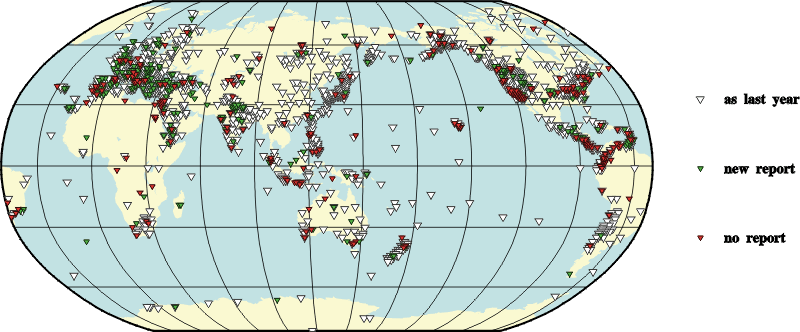
The value of the ISC Bulletin is totally dependent on the network of stations around the world reporting their data to the ISC in time for analysis. The above map represents the stations which have contributed at least one reading which was actually associated to an event in the ISC Bulletin. As usual, the total number of such stations in year 2001 was large: 3085. The turnover of the reporting stations is also large. 12% of the total number have not reported during the previous year (green circles). 10% of the stations reported in year 2000 have not reported in 2001 (red circles). This is due to various reasons such as: some station were closed or moved far enough to warrant another station code or the contact with a network was lost and the data had not been contributed.
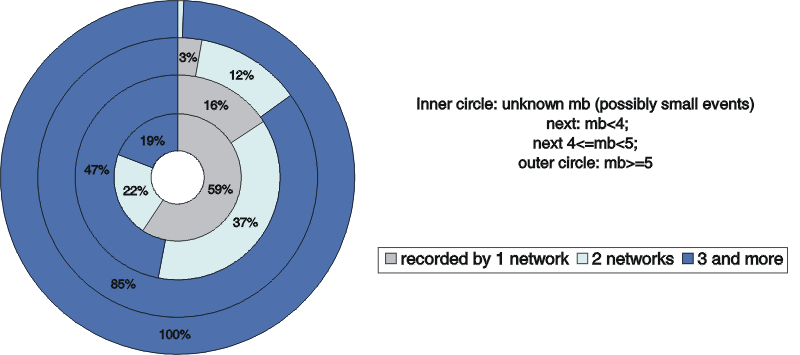
Generally the ISC locations are more reliable if phase readings of at least two different networks are used. The ISC hypocentre will almost always be less accurate than a local one if station readings from only one network are used. This is due to the ISC using Jeffreys - Bullen travel times as opposed to the more appropriate local travel times used by local agencies.
The figure to the left shows a distribution of ISC events with the number of distinct networks which reported it. The grey coloured part of the pie chart represents events based on station readings from just one network and therefore generally least accurately located by the ISC. Light and dark blue colour represent more accurately located events.
Generally, the greater the magnitude, the bigger proportion of events reported by several networks.
Overall 79% of ISC events with a magnitude above the ISC completeness threshold of 3.8 mb were reported by at least 3 networks.
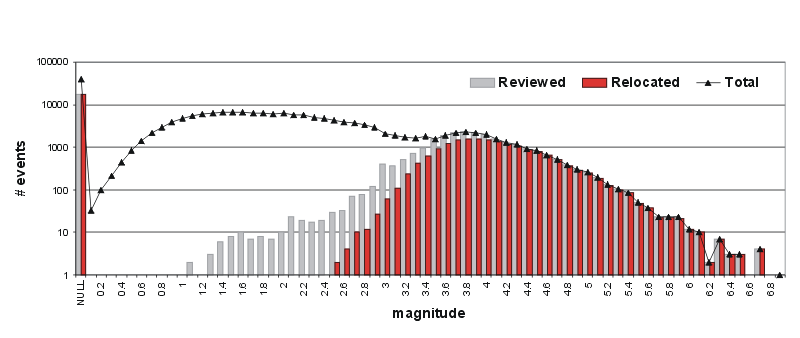
There has been no collection threshold applied at the ISC for the data year 2001. All reported events, regardless of size, have been parsed to the ISC database, processed automatically and made available to the ISC users. When it came to a manual review of the automatic bulletin, the ISC had to apply certain magnitude threshold as it could not afford to review every event. This year we concentrated on events with magnitude 3.5 and above. Apart from these, we also reviewed events with station readings reported at distances of more than 10 degrees, as well as events with reports from at least two different networks.
The ISC only attempts relocating events from the reviewed part of the bulletin. 15% of the total number of reviewed events could not have been relocated by the ISC due to the lack of required number of station reports of P- and/or S-arrivals or poor azimuthal coverage of those reports. One of the problems is that some of the agencies still report us hypocentres but not station readings on which those hypocentres were based.
CONTRIBUTORS TO THE ISC mb AND MS
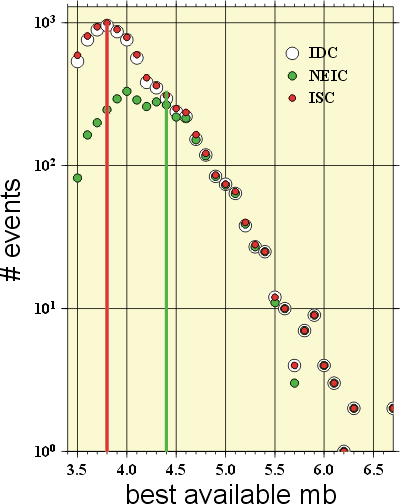
We tried to establish a completeness of three most comprehensive global bulletins: IDC, NEIC and ISC. To compare thresholds of completeness like for like we did not simply use original IDC and NEIC values of depth and magnitude. Instead, for each event from any of three bulletins, we used the best available depth and magnitude estimate available to the ISC. So the same physical event reported by all three agencies is represented by the same magnitude and depth. We only considered hypocentral solutions at depth less than 33km with available mb estimate.
The ISC bulletin is the most complete for mb by default, as almost all IDC and NEIC events become part of the ISC bulletin. The IDC bulletin, however, is almost as complete as the ISC’s. The magnitude threshold is around 3.8 mb. NEIC bulletin is much less complete with a threshold of 4.4 mb. The reason for such difference is that the IDC forms an event if at least three station/array data are available. The accuracy of these locations is low. Such locations with rare exceptions get adopted by the ISC as the best available estimates. NEIC does not routinely include such events in it's bulletin.
Here we only use events with available mb estimate. One has to remember that if magnitudes of smaller events were taken into consideration, than ISC bulletin would be profoundly more comprehensive source of data than any of IDC or NEIC.
One should expect large regional variations of completeness due to predominently continental position of seismic networks.
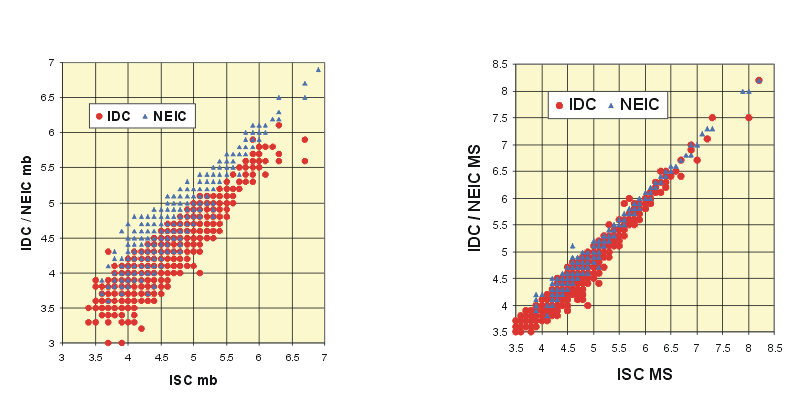
Below we only considered shallow events common to ISC and IDC (NEIC), where both ISC and IDC(NEIC) mb and MS estimates are available. Such estimates were only considered reliable if based on more than 5 station measurements.
It is clear that the IDC mb and MS values are generally smaller than those of ISC. This is possibly caused by certain deviation from standard procedures at IDC. In particular:
- non-standard digital filtering of waveforms prior to taking measurements;
- non-standard measurement procedures;
- constant use of arrays;
- predominantly low noise station positioning.
RELATIVE NUMBER OF VARIOUS SEISMIC PHASE REPORTS
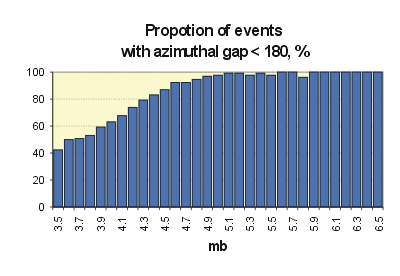
The ISC Bulletin contains a large
variety of seismic phases, but until data year 2001 only P arrivals
were used by the ISC for location. The graph above shows that nearly
all mb>=5 events in the bulletin have an azimuthal gap < 180
degrees, if only P arrivals are taken into account. For certain smaller
events the azimuthal gap may be too large to guarantee a confident
location. For instance, only 63% of mb 4.0 events have an acceptable
gap. In such cases, use of arrivals other than P can assist in
computing more constrained hypocentres, even if the P gap stays
insufficient.
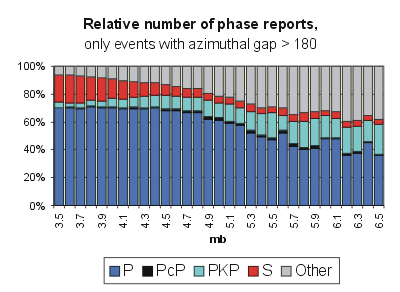
The above graph shows a relative number of reports for
each of P, S, PcP and PKP for those poorly constrained events with
azimuthal gap in excess of 180 degrees.
For almost all mb at least 30% of all reports are phases other than P. These additional phases could be used for event location. In fact, starting with year 2001, the ISC has been successfully using both crustal and teleseismic S arrivals for location. As far as PKP tables are concerned, PKPbc branch of Jeffreys-Bullen tables, the most often reported at distances 144-157 degrees, is known to be incorrect. So using PKP would involve either correcting J-B or using different travel time tables.
For almost all mb at least 30% of all reports are phases other than P. These additional phases could be used for event location. In fact, starting with year 2001, the ISC has been successfully using both crustal and teleseismic S arrivals for location. As far as PKP tables are concerned, PKPbc branch of Jeffreys-Bullen tables, the most often reported at distances 144-157 degrees, is known to be incorrect. So using PKP would involve either correcting J-B or using different travel time tables.
USING S-ARRIVAL TIMES FOR LOCATION
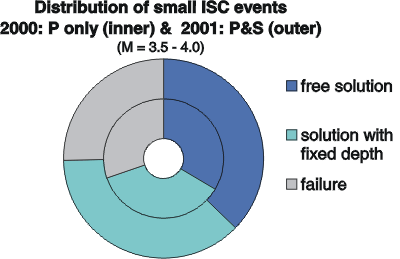
For the first time in it's history the ISC used local and teleseismic S-arrival times for location. The advantage is mostly visible for small events, where previously the number and azimuthal coverage of reporting stations were sometimes not sufficient to achieve a free (neither origin time, no latitutude, longitude or depth are fixed) or fixed depth ISC location. As it appears from the upper graph, the number of events with free ISC solution as well as the overall number of solutions have increased in 2001 as compared to 2000. Overall as many as 85% of all reviewed events for 2001 were relocated by the ISC, based on all collected station reports of P and S.
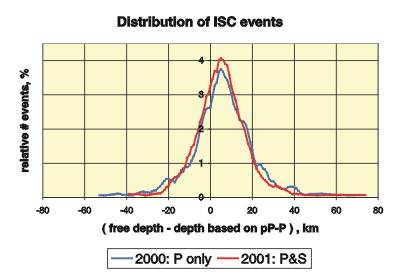
As expected, S-arrivals provided a better constraint on the event depths. In particular, the ISC free depth determinations in 2001 became slightly more consistent with ISC depths based on the pP-P reports as compared to 2000.
The ISC bulletin includes both NEIC & IDC data, so there would be at least as many station readings in each ISC event as with NEIC & IDC. However, the total number of readings is not as important for an accurate location as azimuthal gap. Above we have compared the azimuthal gaps of data sets, used by three agencies for location of common events. We have taken into account, that neither ISC nor NEIC use PKP arrivals for location, although IDC does. Therefore azimuthal gap of defining stations for some IDC events could be smaller at times. Both ISC/NEIC & ISC/IDC comparisons show that much fewer ISC events have a gap exceeding 90 and 180 degrees. As we have explained above, the superiority in azimuthal coverage of the ISC data set over the IDC one would be even bigger, had the ISC used PKP arrivals for location.

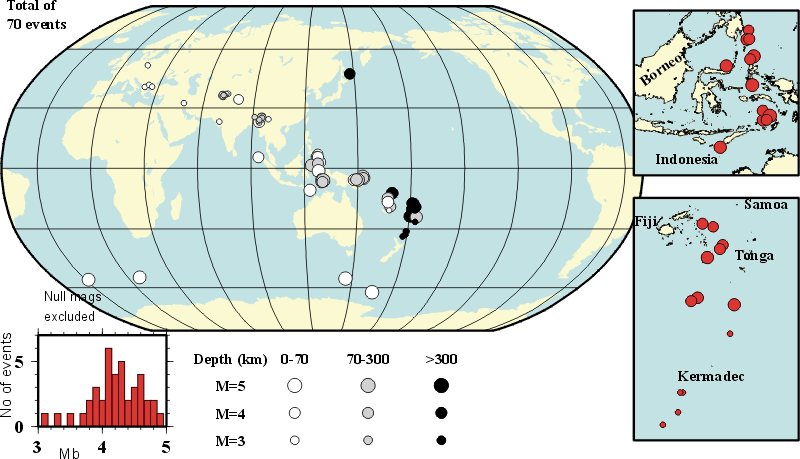
Since 1974 the ISC has searched its unassociated phase readings to find events not reported by other agencies ("search” events). These would be events in remote areas, events in border regions and also small events, often ignored by the ISC in the past to avoid constraints on the data management and analysis system. Since 1999 the ISC has entirely removed all data collection thresholds and the number of search events dropped as a result. We now believe that the majority of the ISC search events are genuinely new. The areas include border regions in the Balkans, Turkey, Hindu Kush, Burma and the Pacific rim.
A small number of events were found this year on the mid-oceanic ridges. These events are usually reported by the IDC. In 2001 the IDC has not produced it's bulletin for 12 days due to technical reasons, which allowed the ISC to find a number of additional genuinely new events.
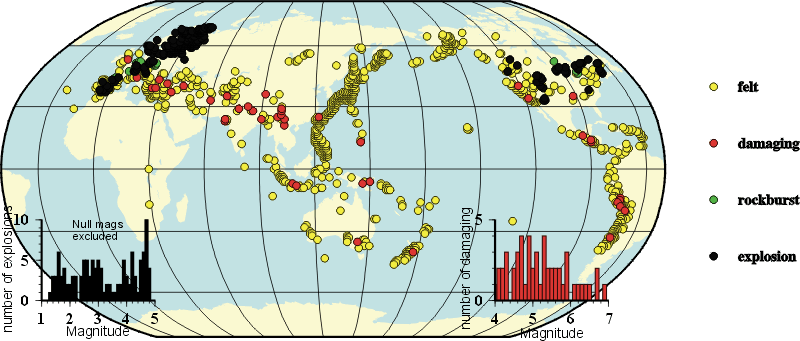
Above we have reproduced those events which were either caused by human activities or felt by people or caused damage. The distribution of the felt events generally matches the areas where both the level of seismicity and population are high. The distribution of explosions and rockbursts generally matches the areas of industrial activities. One could, for instance, observe a large number of explosions/rockbursts in Scandinavia, Northwest Russia, Germany, Poland, Slovenia, France and the United States. Unfortunately there are no reports from other areas with comparatively high level of industrial activities. In fact, some agencies prefer to exclude artificial events from their catalogues as opposed to marking them as artificial. This is not always the best approach. Such events are likely to be reported by neighbouring agencies or even by international data centres, who generally will not have precise information on the nature of the event. Having appreciated the sensitive nature of this issue, the ISC asks where possible to report artificial events along with natural ones.
ON-LINE ISC BULLETIN
The ISC Bulletin is
available on-line. A search tool allows users to select required data
from the Bulletin. It is important to select an appropriate bulletin
type in order to receive a desired outcome. The table below provides
some guidance on the contents of each type of the ISC bulletin, it's
variabilty, availability, typical total number of events along with
drawbacks to be aware of when requesting data on-line.
Type |
Collected |
Published |
Comprehensive |
Contents
|
|
|
|
|
Variability |
Changes with every new
report; provisional agency reports get swapped for final reports |
Stays exactly the same
after the end of manual review |
Changes with every new
report or correction |
|
Availability |
Soon
after an event reported |
20 - 22
months after an event occurs |
Soon
after an event reported |
|
Total, events |
277,527 |
41,705 |
191,016 |
|
Warnings |
|
16% of all events have
not been relocated by the ISC due to the lack of necessary station
reports. In this case one of the reported solutions is chosen as prime |
|
- The 2001 ISC Bulletin remains the most comprehensive global source of seismic parametric data.
- The overall completeness threshold for shallow events is found to be close to 3.8 mb. This threshold is nevertheless subject to a large regional variation.
- As much as 79% of the ISC events with magnitude above the completeness threshold are located based on station readings from a minimum of 3 networks.
- The ISC Bulletin events generally have smaller station azimuthal gap than those of NEIC and IDC (CTBTO).
- The use of S-arrivals has improved the convergence statistics for small events and helped to better constrain the ISC depths. The use of other phases like PcP and PKP would be beneficial.
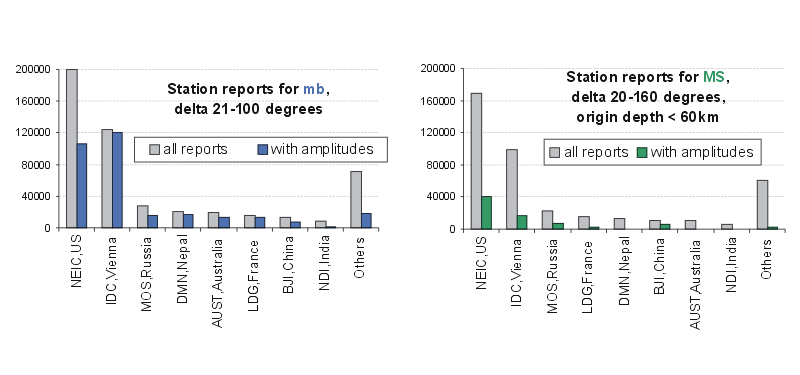
- The ISC mb values are dominated by the body wave amplitudes from IDC (38% of the total number) and NEIC (34%). As much as 99% of surface wave amplitudes for ISC MS are contributed by only 5 sources: NEIC, IDC, MOS (Russia), BJI (China) and LDG (France). The ISC Bulletin would benefit from other agencies contributing amplitudes.
- ISC mb / MS are generally consistent with those of NEIC. IDC mb / MS are generally smaller than ISC.
- The number of new events discovered by the ISC, based on unassociated station reports, declines as more comprehensive local reports are received.
- The ISC Bulletin would benefit from station reports contributed as associated to known hypocentres.
